Science Fair Competition of Maryland
Science Camp 2013
 |
| Long Green School House |
People learn in different ways. Some benefit most from being
told what to do. Others respond best to those who lead by example. Some people
are visual learners, some need to work with their hands to really grasp
concepts and apply them to larger lessons. Children are playful, active, easily
distracted, brilliantly imaginative, and receptive to learning new things. They
learn by seeing for their selves what cause and effect means, what consequences
are, what miracles are. Proverbs 9:9 reads, “Give instruction to a wise man,
and he will be still wiser; teach a righteous man, and he will increase in
learning.” Doing is almost always more affective than simply hearing, and in
children, this concept could not be more true.
 |
| Ava and Sarah |
The Science Fair Competition of Maryland is a non-profit
organization devoted to the mantra that "Inspiration causes motivation for
education." If kids are sitting in an atmosphere that does not promote
exploration or mistake-making or light bulbs going off indicating epiphanies,
education is stunted. On August 14-16, 2013 from 9am to 12pm, thirteen kids and
young teens of varying ages and skill levels arrived at the Long Green School
House on the Lenox Laser campus in Glen Arm to learn by doing. The campers’
first names are Brie, Jada, Sarah, Milada, Ava, Tommy, Owen, Caleb, Evan, Justin,
London,
Scarlett, Lilly, and Ellie. Each day began with the Pledge of Allegiance, an
applicable and age-appropriate Bible verse, and a quick morning prayer. The
campers, especially the kindergarten-bound ones, loved practicing the pledge
loudly and proudly in a friendly environment, and one child a day had the honor
of holding the American Flag. Rachel Hoffman, Camp Coordinator Extraordinaire,
led the activities for each event, having chosen fun themes in place to focus energies
each day.
 |
| A look inside The "Galeidoscope" |
 |
| Tommy using a magnifying glass to melt marshmallows |
Wednesday the 14
th, the first day of camp, was
“Outrageous Optics” day! The kids were able to enjoy a variety of crafts and
learning experiences that all pertained to perception, light, and the eye. Out
of “Outrageous Optics” many innovations were born. The main task of the day was
to build a kaleidoscope using cardboard PVC pipes, rubber cement, construction
paper, wax paper, regular kitchen plastic wrap, rubber bands, and various gems
and miscellaneous “bling.” Thomas P. Hoffman discovered that if he put one
large-cut play gem at the end of the tube instead of a sprinkling of little
jewels between the layers of plastic, he could create the optical illusion that
really resembled the experience of looking through a kaleidoscope. He then took
this further by flipping the whole contraption upside down and looking at the
gem from the outside and holding it to the light, instead of from the hole cut
in the wax paper at the top. The effect was beautiful. He called this the “Galeidoscope.”
Rachel put together a “History Minute” segment of the day where she would lead
kids in small groups through a lesson on the day’s topic. The first day
featured 3-D glasses to accompany the 3-D images on the wall as well as a brief
definition and overview of what optics are and what their function is. The kids
enjoyed playing a round of musical chairs using the kids’ Christian radio
station that played music lightly through each event. Rachel showed the
participants how to craft a reflection oven using a pizza box with plain
aluminum foil on the top and black aluminum foil on the bottom to cook s’mores
for a snack using just the sun to melt the chocolate and marshmallow. The
highlight of the morning was when the kids used a magnifying glass to ignite
sparklers. The kids loved seeing the spectacle, knowing that they were able to
light them and set them off without a lighter or matches! They were in awe.
 |
| Justin and Evan test drive a "Whacky Wheels" invention |
.JPG) |
| The official Science Camp 2013 Mobile! |
.JPG) |
| Mr. Scott working on the Segway |
The theme on Thursday, August 15
th, was “Whacky
Wheels.” When the kids arrived, they were able to decorate boxes with stickers
and drawings so that the boxes could be used to hold all of their treasures and
inventions from throughout the week. They were then given free reign to ride one
of several play cars that are battery operated, taking turns, racing, and
having fun. The group moved then from the school house to the Quonset hut on
campus where Mr. d’Entremont and Doug Blake assisted the kids in many exciting
projects, like attaching a cart and third wheel to a standard bicycle so that
the rider could accommodate two more kids in the front, and a Segway of sorts
made from a large trash bin, corrugated metal rods, a board, three wheels, and
some handlebars. The inventions had something in common and that is the
placement of the single wheel in the back, with the
adjacent double wheels in the front, making these vehicles constructively
unlike the tricycle- a true innovation. This building process took most of the
camp time because the kids and staff were on a roll coming up with new ideas to
improve mobility. Mr. d’Entremont mentioned that in the Segway process, it was
IT employee, Ryan Pilius who really, “Set the wheels in motion.” He was responsible
for brainstorming the logistical possibilities of balance and weight
distribution while adjoining the rods and wheels to the barrel along with Mr. Scott,
the father of a camper and avid enthusiast of hands-on learning. Ryan was
involved in the camp all three days, getting to know the kids, and taking many photos
and videos that will help the team remember the success of the event. One of
the play cars from before, a bright yellow mustang to be exact, was covered in
paper and decorated during this time as well so that every child had the
opportunity to think outside of the box and get creative. The car turned out
beautifully with balloons and tinsel streamers, glitter messages, bedazzled
headlights, and a customized license plate.
 |
| Brie's Ferris wheel from "Radical Robotics" |
 |
| London and Lilly in construction mode |
 |
| Jada |
The last day was centered on “Radical Robotics.” Once more,
Rachel taught the kids about the history and practice of robotics while showing
fun posters of a vending machine and none other than
Optimus Prime as relatable examples of science taking root in everyday life.
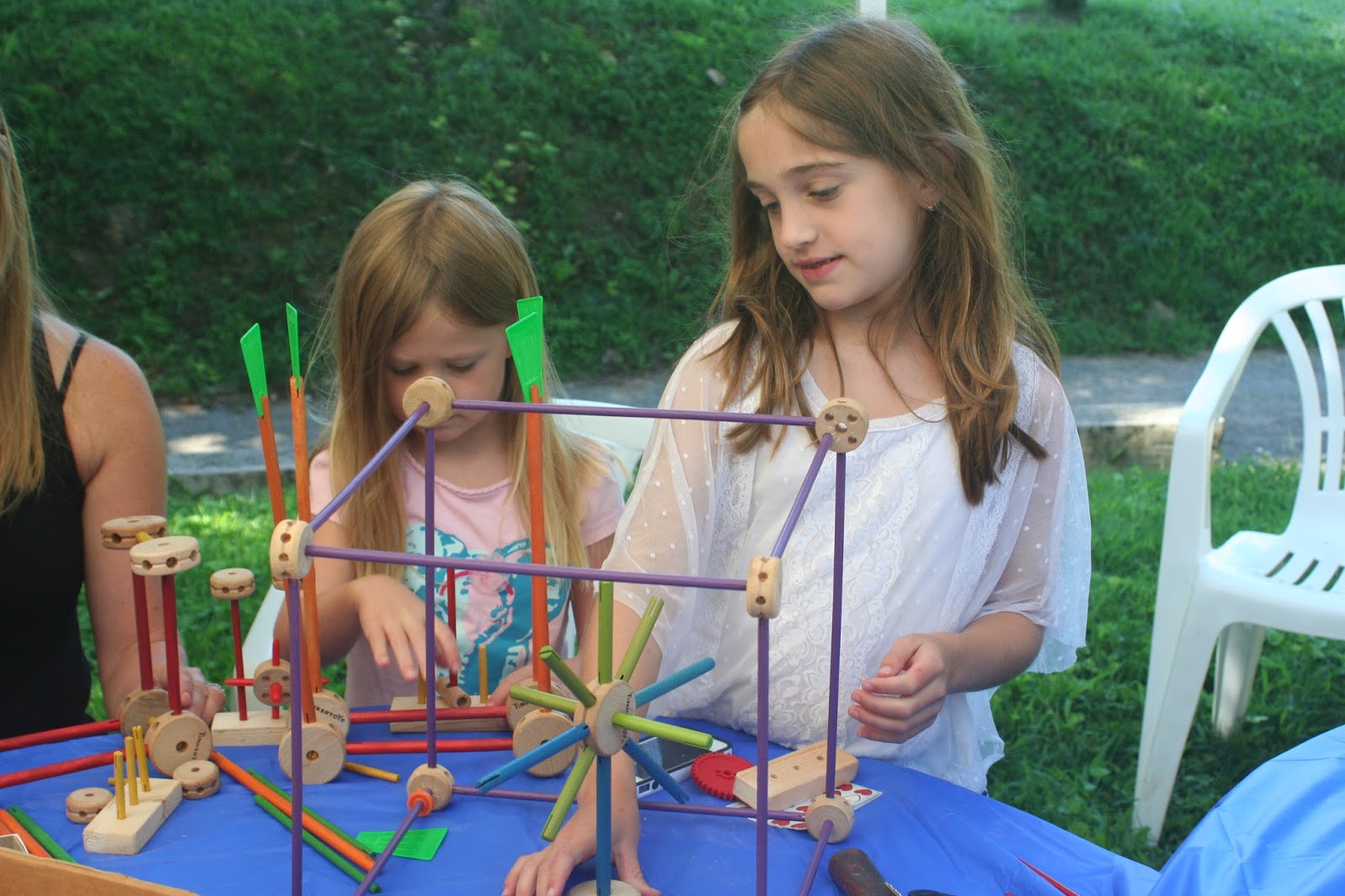
The star of the day was the first assignment to build a
robot/car/animal/machine using Joe’s peg blocks, Pegoes, Legos, tinker toys,
ball and joints, wooden wheels, string, fins- anything in the school house from
old-school rudimentary blocks to building toys that create highly efficient
structures. The kids went nuts! Sarah had the idea to make things relating to
the circus, so she and Lilly got to work on a flying trapeze and tightrope
complete with death-defying drops and glittery string. Brie created a fully-functioning
ferris wheel with Lego bucket seats, and a stand that really let the thing
spin. There were awesome cars, and buses with many people on board, and bona
fide robot action figures. It was nothing short of impressive that everyone
worked together so well and kept at it until they had really become proud of
their work. The kids were beaming with pride over what their imaginations had
cooked up. We then shifted gears to another building exercise, only this time,
the robots were edible! Pretzels, vanilla frosting, marshmallows, and graham
crackers were used to make butterflies, snowmen, cars, and monsters, which
lived only long enough to withstand the three-second countdown before everyone
devoured the fruits of their labor. Joe then led another workshop experience up
at the hut where demonstrations took place of how engineers use the same
fundamentals learned all morning about the certainties of gravity, inertia, and
strong foundational integrity to create things using steel and tools. The major
players were Joe’s e-blox as they came together to form a stand that could hold
a magnifying glass in place to catch the sunlight at the perfect angle and
light the end of two cherry bomb fireworks- hands-free! This certainly tied up
the week nicely bringing it back to optics. The three days
culminated in a most-distinguished ceremony where the kids entered into Lenox
Laser’s banquet hall where the whole company surprised them with a fancy
introduction and cheers. The smiles and wide eyes on those faces were so genuine
and that image of them reacting to the pomp and circumstance is so
valuable. Rachel created a slideshow of all of the pictures taken throughout
the camp that played in the background while the whole company and the kids ate
a complimentary lunch and opened their self-decorated boxes now filled with
little goodies like jump ropes, creepy crawly rubber bugs, toy cars, and of
course the kaleidoscopes they had made on the first day plus framed pictures of
them in action playing with their new friends and learning through experience.
 |
| Brie, Ellie, and Ava |
 |
| Joe, Shelby, Rachel, and Owen as he receives his award |
 |
| Mr. Scott and Evan |
 |
| The hands-free fireworks launcher made from e-blox |
 |
| Scarlett |
This camp contextualized science, technology, and
inventions, and put into practice what kids learn in their classes during the
school year in a safe, fun environment. Brie, a 14-year-old participant was
eager to know that we will be hosting this camp again next summer because she
had such a good time and loved using her creativity and serving heart to help
others and show the endless possibilities of innovation by setting a good
example. Evan, Mr. Scott’s son loved meeting the other boys and causing a
harmless ruckus by learning about cars and setting things on fire and doing
what young boys do best. Milada loved gluing jewels and adding
the letter ”M” and the number “5” to everything she touched so that people
would know an intelligent 5-year-old with an “M” name was there and she was
proud to be a part of it. Brothers Tommy and Owen learned a lot about the laws
and principles of optics, having both tried the new “Galeidoscope” technique to
see things a bit differently. Justin loved robotics day and loved creating cool
menacing transformers that could implement the lessons he had learned. Jada,
another young teenager who was friends with Brie, came out of her shell more
each day until she was in her element behind the camera helping us take
pictures and playing tag with the younger boys and girls. Her smile let on that
she was so happy to be here. Sisters London, Scarlett, and Lilly were fortunate to
have their mom Rachel Krafft stay for the days with them so they got a great
mother-daughter understanding of how to show off what they had made right away
to the person who meant most to them and be excited to know that they had done
it all on their own. Caleb, the younger brother of Tommy and Owen, proved to be
helpful and friendly to the other kids while still being the rambunctious
little kid we all love. Ava was a shining light all three days with her
adventurous spirit and willingness to try every new thing and even roughhouse
with the boys! She is a firecracker with a longing to hold onto everyone around
her and build lasting moments with kids her age as she deals with her diagnosis
of leukemia. Ava’s buddy who she was inseparable with in just three days was Sarah.
Sarah is one of the sweetest girls I have ever met. She loved to be fair, take
turns, and teach kids how to be patient and how to have a ton of fun while
making goofy faces and not taking anything too seriously. She was so excited to
exchange phone numbers with Ava’s mom so that they could stay in touch. Ellie
was a young teenager who arrived the last day, but she jumped right in and
participated beautifully with an amazing peg structure during building time and
a free-spirited heart to help where she was needed and make the most out of the
time she could spend meeting everybody.
 |
| Lighting Sparklers |
 |
| Tom Hoffman conducting a tour of the lab for the kids |
The 2013 summer camp was a hit! There is no doubt that this
will continue in the coming years. The potential for an after-school program
even exists, so that the ball can start rolling on these great opportunities
for kids to learn in a new way sooner rather than later, and year round! This
place is unlike any other. The Christian standard of equality, education and
love is apparent at every facet of the company and non-profit organization.
Science Fair Competition of Maryland is the place to be.
See, Hear, Do, Learn, Teach.
 |
| Campers, parents, and coordinators after the closing ceremony on the 16th |


.JPG)
.JPG)



.JPG)


